10.1.- THEORETICAL - PRACTICAL FUNDAMENTALS

Automatic control is the branch of engineering that deals with the regulation of the operation of equipment, processes or complete plants, using a set of devices and mechanisms called control system. The open-loop control systems act on the input of the system (actuator) without taking into account the value of the output. However, the operation of the closed-loop systems isbased on the feedback of the parameter to be controlled (controlled variable). In these systems, a sensor measures the corresponding variable and, by means of a controller, the measured value is compared with the desired value (setpoint). Depending on the difference obtained in the comparison (error), an action is carried out on the control variable...

View more

The classical control theory establishes two important steps when designing a suitable control strategy: the system identification and the control algorithm definition. In the identification process, the most commonly used methods are based on the analysis of the system time response (reaction curve method), the analysis of the frequency response (Bode plot) or on obtaining a mathematical model based on the Laplace transform. Depending on the system model obtained (for example, a first order system, a second order system or an integrator) and the specifications to be fulfilled (a certain peak time in a closed-loop, a certain time constant, etc.), an appropriate control strategy is proposed. The PID control (proportional-integral-derivative) and those strategies based on this type of control (cascade control, multivariable control, feedforward control, selective control, etc.) are the most important ones, together with the phase lead compensators and phase lag compensators.

Due to the advantages provided by the control systems, new identification methods and advanced control algorithms are being studied. Some examples are the ARM, ARMAX and least squares fitting identification methods and the adaptive control, the predictive control and the fuzzy control algorithms.

View Products

THEORETICAL - PRACTICAL FUNDAMENTALS EQUIPMENT

Showing 1-17 of 17 item(s)
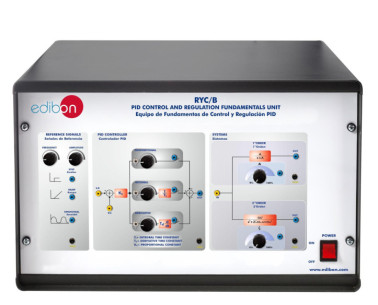
PID CONTROL AND REGULATION FUNDAMENTALS UNIT - RYC/B
  • RYC/B
Available
6.1.1.1.- THEORETICAL-PRACTICAL FUNDAMENTALS

RYC/B

PID Control and Regulation Fundamentals Unit

The regulation of dynamic systems is a fundamental component of engineering, as it allows process variables to be maintained within desired limits despite external disturbances or internal changes. To achieve this, control strategies such as the...
COMPUTER CONTROLLED MODULAR CONTROL AND REGULATION UNIT - RYC/T
  • RYC/T
Available
10.1.- THEORETICAL - PRACTICAL FUNDAMENTALS

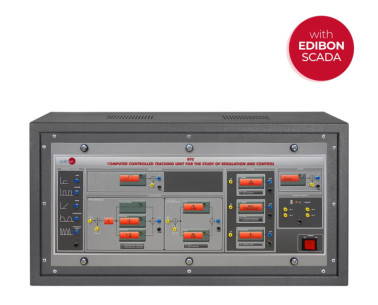
RYC/T

Computer Controlled Modular Control and Regulation Unit

The Computer Controlled Modular Control and Regulation Unit, with SCADA and PID Control, "RYC/T", has been designed by EDIBON for the study of regulation and automatic control through experimentation with real processes and dynamic models. It...
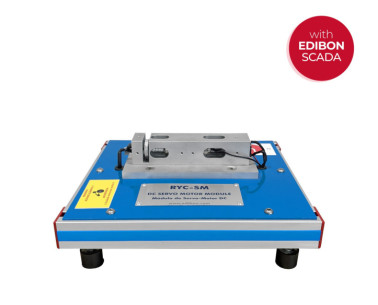
PID CONTROL AND REGULATION OF A DC SERVOMOTOR UNIT - RYC-SM
Available
6.1.1.1.- THEORETICAL-PRACTICAL FUNDAMENTALS

RYC-SM

PID Control and Regulation of a DC Servomotor Unit

Accessory of RYC, RYC/T
The PID Control and Regulation of a DC Servomotor Unit, "RYC-SM", designed by EDIBON, allows studying speed and position control in a DC servomotor. It includes speed and position sensors, allowing analysis of the dynamic response of the motor and...
PID TEMPERATURE CONTROL AND REGULATION OF AIR FLOW UNIT - RYC-TAR
Available
6.1.1.1.- THEORETICAL-PRACTICAL FUNDAMENTALS

RYC-TAR

PID Temperature Control and Regulation of Air Flow Unit

Accessory of RYC, RYC/T
The PID Temperature Control and Regulation of Air Flow Unit, "RYC-TAR", designed by EDIBON, allows studying temperature control in an air flow using a fan and a heating element. It includes sensors distributed along the duct, allowing analysis of...
PID CONTROL AND REGULATION OF AN INVERTED PENDULUM UNIT - RYC-PI
Available
6.1.1.1.- THEORETICAL-PRACTICAL FUNDAMENTALS

RYC-PI

PID Control and Regulation of an Inverted Pendulum Unit

Accessory of RYC, RYC/T
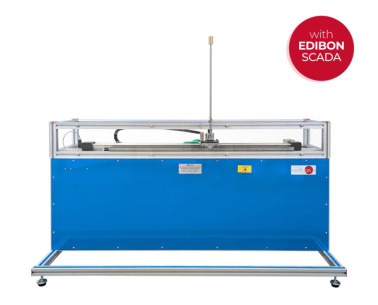
The PID Control and Regulation of an Inverted Pendulum Unit, "RYC-PI", de­signed by EDIBON, allows studying a highly unstable process through the control of an inverted pendulum mounted on a moving carriage. It includes position and angle sensors...
PID MAGNETIC LEVITATION CONTROL AND REGULATION UNIT - RYC-CLM
Available
6.1.1.1.- THEORETICAL-PRACTICAL FUNDAMENTALS

RYC-CLM

PID Magnetic Levitation Control and Regulation Unit

Accessory of RYC, RYC/T
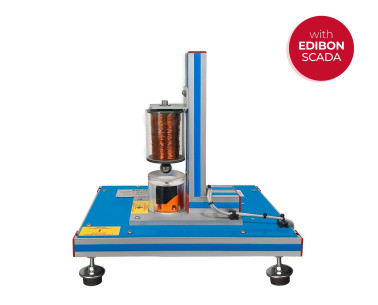
The PID Magnetic Levitation Control and Regulation Unit, "RYC-CLM", desig­ned by EDIBON, allows studying a highly nonlinear process through the levitation of a metallic ball using an electromagnet. It includes position and current sensors that...
PID TEMPERATURE CONTROL AND REGULATION UNIT - RYC-TE
Available
6.1.1.1.- THEORETICAL-PRACTICAL FUNDAMENTALS

RYC-TE

PID Temperature Control and Regulation Unit

Accessory of RYC, RYC/T
The PID Temperature Control and Regulation Unit, "RYC-TE", designed by EDI­BON, allows studying temperature control in a tank using a heating element and temperature sensors. It allows analyzing thermal dynamics, response time, and process stability.
PID CONTROL AND REGULATION OF PRESSURE LEVEL UNIT - RYC-P
Available
6.1.1.1.- THEORETICAL-PRACTICAL FUNDAMENTALS

RYC-P

PID Control and Regulation of Pressure Level Unit

Accessory of RYC, RYC/T
The PID Control and Regulation of Pressure Level Unit, "RYC-P", designed by EDIBON, allows the study of pressure control in a tank using compressed air. It includes a compressor, pressure sensors, and control valves. It allows analyzing the...
PID LEVEL CONTROL AND REGULATION UNIT - RYC-N
Available
6.1.1.1.- THEORETICAL-PRACTICAL FUNDAMENTALS

RYC-N

PID Level Control and Regulation Unit

Accessory of RYC, RYC/T
The PID Level Control and Regulation Unit, "RYC-N", designed by EDIBON, allows studying level control in a tank by regulating the inlet flow. It includes level sensors, a pump, and valves that allow modifying operating conditions. The unit allows...
PID FLOW CONTROL AND REGULATION UNIT - RYC-C
Available
6.1.1.1.- THEORETICAL-PRACTICAL FUNDAMENTALS

RYC-C

PID Flow Control and Regulation Unit

Accessory of RYC, RYC/T
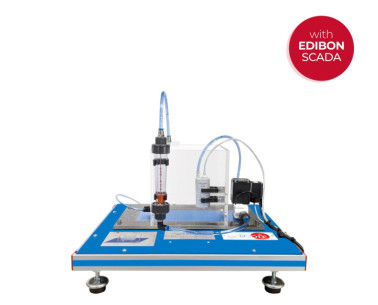
The PID Flow Control and Regulation Unit, "RYC-C", designed by EDIBON, allows the study of flow control in a closed hydraulic circuit. It includes a pump, a flowmeter, and an electronic proportional valve that regulates the flow. The unit allows...
PID CONTROL AND REGULATION OF LIGHT INTENSITY UNIT - RYC-I
Available
6.1.1.1.- THEORETICAL-PRACTICAL FUNDAMENTALS

RYC-I

PID Control and Regulation of Light Intensity Unit

Accessory of RYC, RYC/T
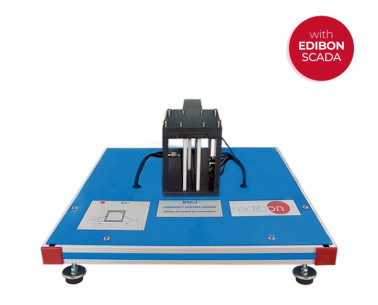
The PID Control and Regulation of Light Intensity Unit, "RYC-I", designed by EDIBON, allows analyzing light intensity control in a closed environment. It includes a variable light source and several optical sensors, such as photodiodes or...
PID CONTROL AND REGULATION OF PH LEVEL UNIT - RYC-pH
Available
6.1.1.1.- THEORETICAL-PRACTICAL FUNDAMENTALS

RYC-pH

PID Control and Regulation of pH Level Unit

Accessory of RYC, RYC/T
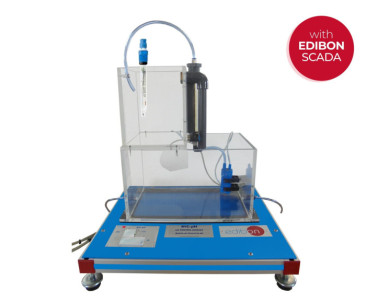
The PID Control and Regulation of pH Level Unit, "RYC-pH", designed by EDIBON, allows studying pH control in a tank by dosing acidic and basic solutions. It includes pH sensors, dosing pumps, and a mixing tank. It allows analyzing dynamic chemical...
PID POSITION CONTROL AND REGULATION OF A MOTOR UNIT - RYC-CP
Available
6.1.1.1.- THEORETICAL-PRACTICAL FUNDAMENTALS

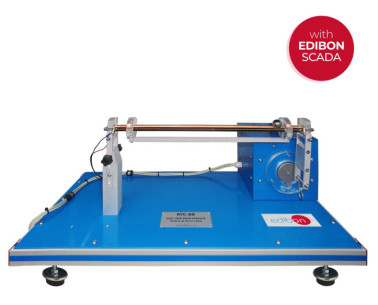
RYC-CP

PID Position Control and Regulation of a Motor Unit

Accessory of RYC, RYC/T
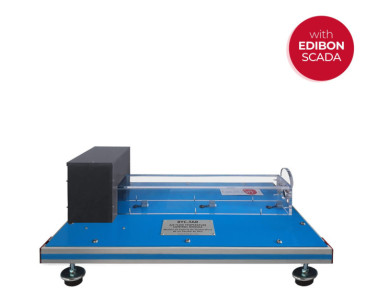
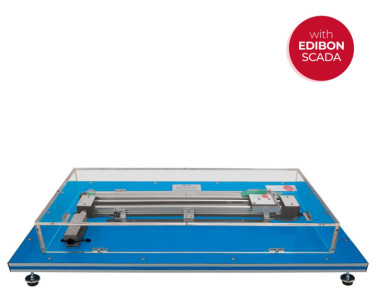
The PID Position Control and Regulation of a Motor Unit, "RYC-CP", designed by EDIBON, allows studying linear position control using a DC motor that moves a carriage. It includes position sensors that allow measuring the displacement of the...
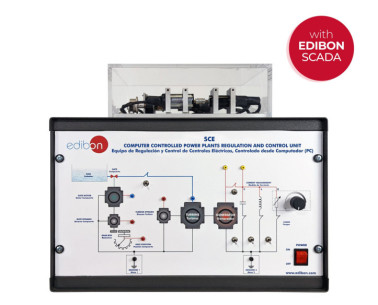
COMPUTER CONTROLLED POWER PLANTS REGULATION AND CONTROL UNIT - SCE
  • SCE
Available
6.1.1.1.- THEORETICAL-PRACTICAL FUNDAMENTALS

SCE

Computer Controlled Power Plants Regulation and Control Unit

The Computer Controlled Power Plants Regulation and Control Unit, "SCE", has been designed by EDIBON to simulate and analyze the behavior of a power plant through two operating modes.Real mode: allows the analysis and data acquisition of the...
Ask for information