AEL-PHIP Photovotaic Systems Application in Isolated and Parallel Grids

PHOTOVOTAIC SYSTEMS APPLICATION IN ISOLATED AND PARALLEL GRIDS - AEL-PHIP

INNOVATIVE SYSTEMS

The Photovoltaic Systems Application in Isolated and Parallel Grids, "AEL-PHIP", has been designed by EDIBON to study the operations carried out in photovoltaic power systems which operate isolated from the national energy grid (island operation) or connected to it (parallel operation).

See general description

RELATED NEWS

General Description

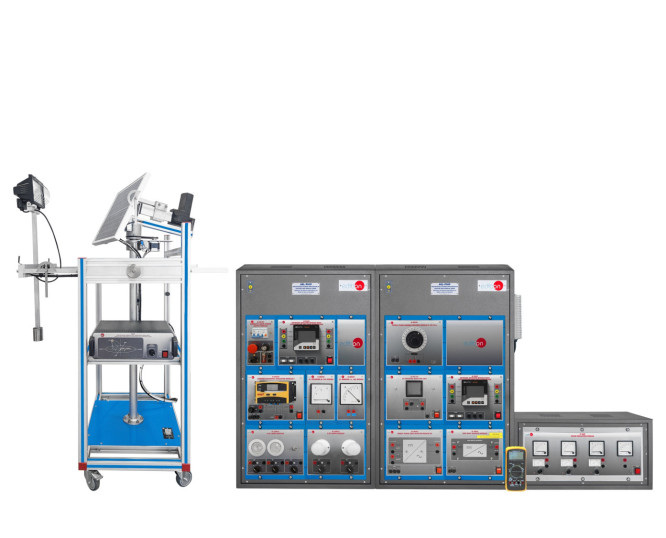
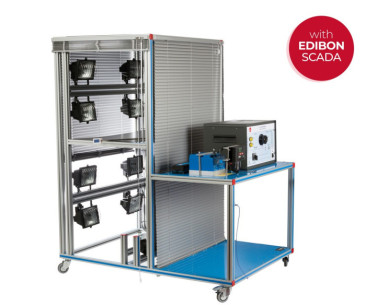
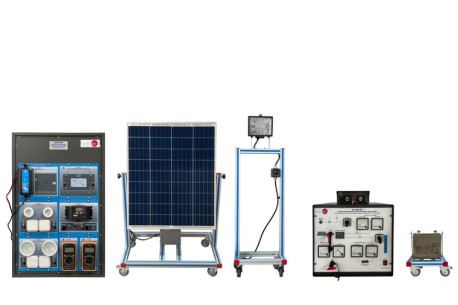
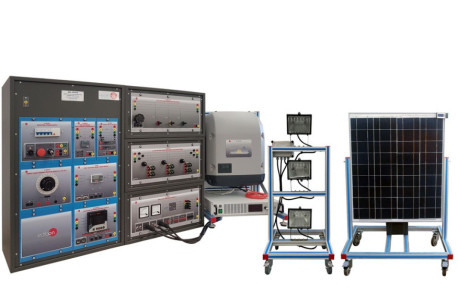
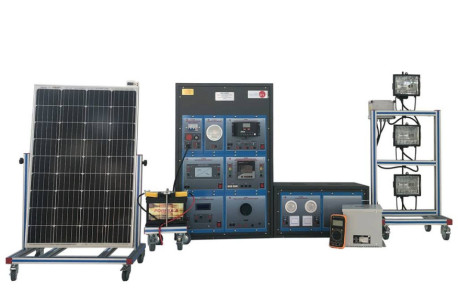
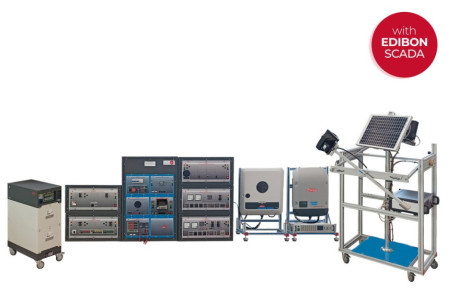
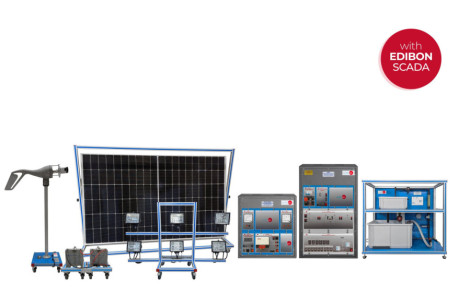
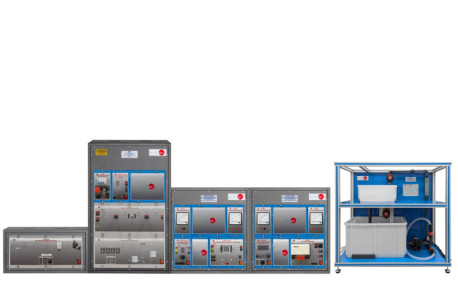
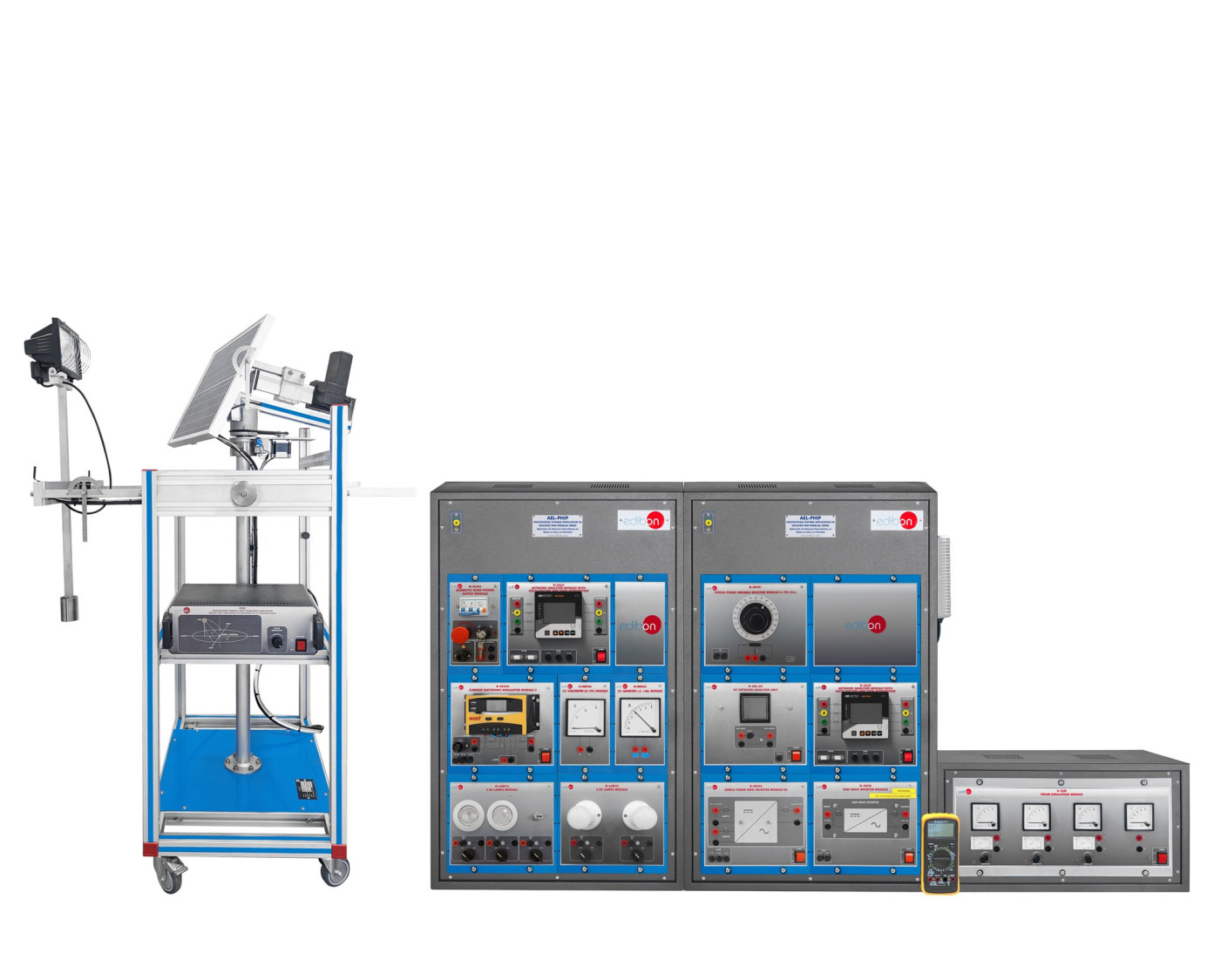
The Photovoltaic Systems Application in Isolated and Parallel Grids, "AEL-PHIP", has been designed by EDIBON to study the operations carried out in photovoltaic power systems which operate isolated from the national energy grid (island operation) or connected to it (parallel operation). This application allows studying the electricity generation by means of photovoltaic panels, through the simulation of different configurations and irradiance conditions, as well as its working in island and parallel to grid operation. To that end, the application also allows proving and understanding the working principles of the different control, regulation and energy storage devices used in real photovoltaic systems. For these purposes, the "AEL-PHIP" application consists of different kits that allow studying several aspects of photovoltaic power plants:

  • PHIP-UB. AEL-PHIP Base Unit.
  • PHIP-K1. Analysis of Series and Parallel Photovoltaic Modules Kit.
  • PHIP-K2. Off-Grid Single-Phase Photovoltaic Systems Kit.
  • PHIP-K3. Single-Phase Photovoltaic Systems for Parallel to Grid Operation Kit.

Each kit's didactic purpose is detailed below:

  • PHIP-UB. AEL-PHIP Base Unit. This unit consists of a solar simulation module comprising three photovoltaic panel simulators, allowing operation without the need for actual solar irradiance on photovoltaic panels. The assembly includes an analog voltmeter to monitor the output voltage of each simulator configuration. Each panel simulator is equipped with an irradiance adjustment control for setting the simulated solar irradiance level and an analog ammeter for measuring the electrical generation parameters.
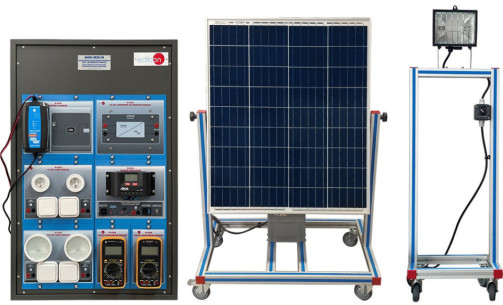
  • PHIP-K1. Analysis of Series and Parallel Photovoltaic Modules Kit:This kit consists of a photovoltaic module assembled on a wheeled structure that allows varying the solar module tilt angle. Thus, different roof tilts or typical structures can be simulated, above which these photovoltaic modules are installed. A halogen lamp mounted on an articulated arm is coupled to the mentioned structure for the sun's path simulation. The lamp has a current regulator which allows controlling the incident irradiance on the photovoltaic panel. In order to simulate the solar panel load, the kit includes a variable resistive load.
  • This kit also includes a solar simulation module consisting of three photovoltaic panel simulators, which allow working without the halogen lamp lighting. Each panel simulator has a regulator for the adjustment of solar irradiance and an analog voltmeter and ammeter for measuring the generation electrical parameters.
  • With this kit, the user will be able to achieve the following learning: daily and yearly curves display, calculation of the photovoltaic modules optimal position, characteristic curves display and photovoltaic modules analysis in parallel, series and other configurations.
  • PHIP-K2. Off-Grid Single-Phase Photovoltaic Systems Kit: This kit consists of all the industrial elements needed to study and understand the operation of a real photovoltaic system which operates in island mode. Firstly, it includes an electronic regulator whose purpose is to control the battery charge flow and the inverter input power flow. In addition, this kit includes a sinusoidal wave inverter which transforms the DC current coming from the regulator into single-phase AC current. Both at the regulator and inverter outputs, AC and DC loads are connected respectively, whose purpose is to consume the generated energy. These loads are AC and DC lamps with different power consumption. This kit also includes a network analyzer for monitoring the system electrical parameters and an analog voltmeter and ammeter with the goal of connecting them to the battery terminals for measuring its operating current and voltage.
  • With this kit the user will be able to achieve the following learning: installation of photovoltaic systems, measurement of the plant electrical parameters and design and operation of photovoltaic systems isolated from the grid in direct or storage operation.
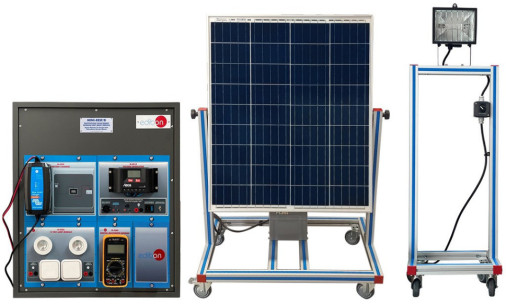
  • K3. Single-Phase Photovoltaic Systems for Grid-Parallel Operation Kit.This kit consists of the industrial elements needed to study and understand the operation of the photovoltaic systems which operate in parallel to the grid mode. To that end, it includes an industrial inverter which provides the grid with the generated power. The grid is represented by the power supply included in the base unit. The grid inverter monitors voltage, current and grid impedance for an emergency disconnection in case of deviations or faults that may be dangerous. This kit also includes a network analyzer for monitoring the electrical parameters of the power flux supplied to the grid.

Exercises and guided practices

GUIDED PRACTICAL EXERCISES INCLUDED IN THE MANUAL

Practical possibilities with the PHIP-K1 kit:

  1. Display of daily and annual curves.
  2. Calculation of the optimal inclination of photovoltaic modules.
  3. Display of characteristic curves for photovoltaic modules.
  4. Operation of shunt diodes.
  5. Configuring photovoltaic modules in series and in parallel.
  6. Analysis of simulated power generation using different configurations of photovoltaic modules and different solar irradiance conditions.

Practical possibilities with the PHIP-K2 kit:

  1. Measurement of electrical parameters from the photovoltaic generation system.
  2. Design and testing of an off-grid photovoltaic system in directconnect and storage mode.
  3. Design and testing of an off-grid photovoltaic system with AC power supply and storage.

Practical possibilities with the PHIP-K3 kit:

  1. Installation of photovoltaic systems.
  2. Measurement of electrical parameters from the photovoltaic generation system.
  3. Design and testing of grid-connected (or parallel) photovoltaic systems.
  4. Determining the efficiency of the industrial inverter.
  5. Analysis of the photovoltaic system’s response to a "black out" of the grid.

MORE PRACTICAL EXERCISES TO BE DONE WITH THE UNIT

  1. Several other exercises can be done and designed by the user.

SIMILAR UNITS AVAILABLE

Quality

AFTER-SALES SERVICE

Ask for information