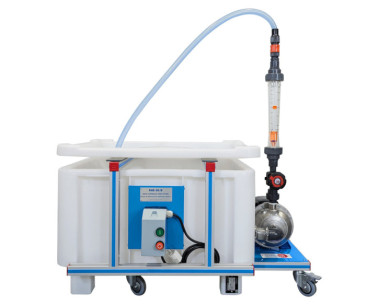
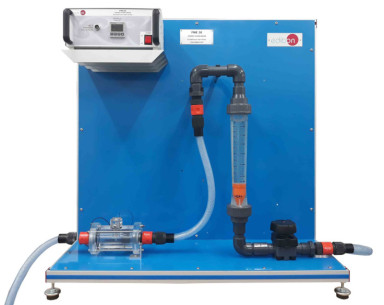
The branch of Fluid Mechanics studies the laws of the behavior of fluids at rest (fluid statics) or in motion (fluid dynamics) and their interaction processes with solid bodies. A fluid is considered to be a substance that can flow, in other words, move. Among them there are liquids (water, oil, alcohol, milk, sulfuric acid, gasoline) and gases (air, oxygen, nitrogen, helium, argon, methane, butane, natural gas).
The fluids can be found everywhere in the everyday life, from the air that surrounds us, the water in the pools and for irrigation, the hydraulic system that allows us to brake in our car, heating or air conditioning, to our own blood system. Fluid studies are based on the well-known Archimedes and Pascal’s principles, Bernoulli’s equation, Venturi effect or Darcy's law, among others. The field of Fluid Mechanics Engineering that seeks applicability is studied empirically and mathematically, highlighting dimensionless numbers such as Reynolds, Prandtl, Mach and Froude. The importance of the fluid mechanics principles have left common inventions, such as water transfers by channels, maritime and air transport, hydraulic, thermal and pneumatic machines, solutions to the problems of cavitation or water hammer in pipes, hydraulic and pneumatic transmissions and controls, etc.
Given the relevance of fluids in diverse applications, it is important to know their nature, that is to say, the type of fluid and describe it based on its properties. The most significant ones are: pressure, temperature, volume, density, viscosity, compressibility, specific heat, thermal expansion and miscibility.
 Cookie preferences