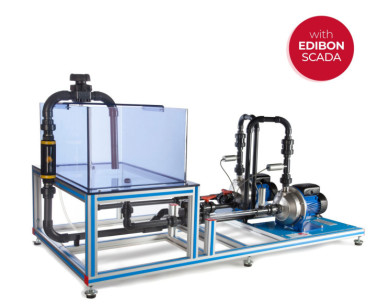
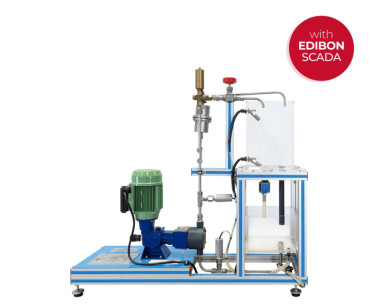
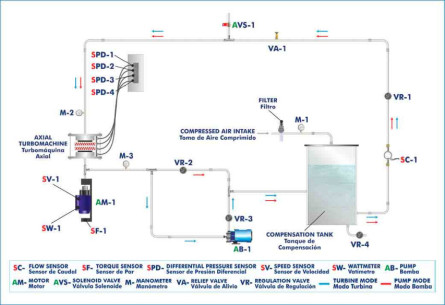
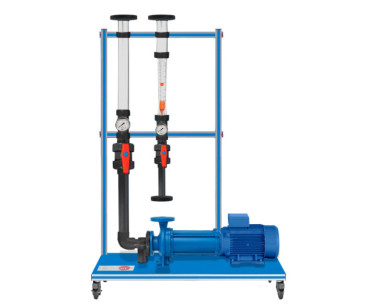
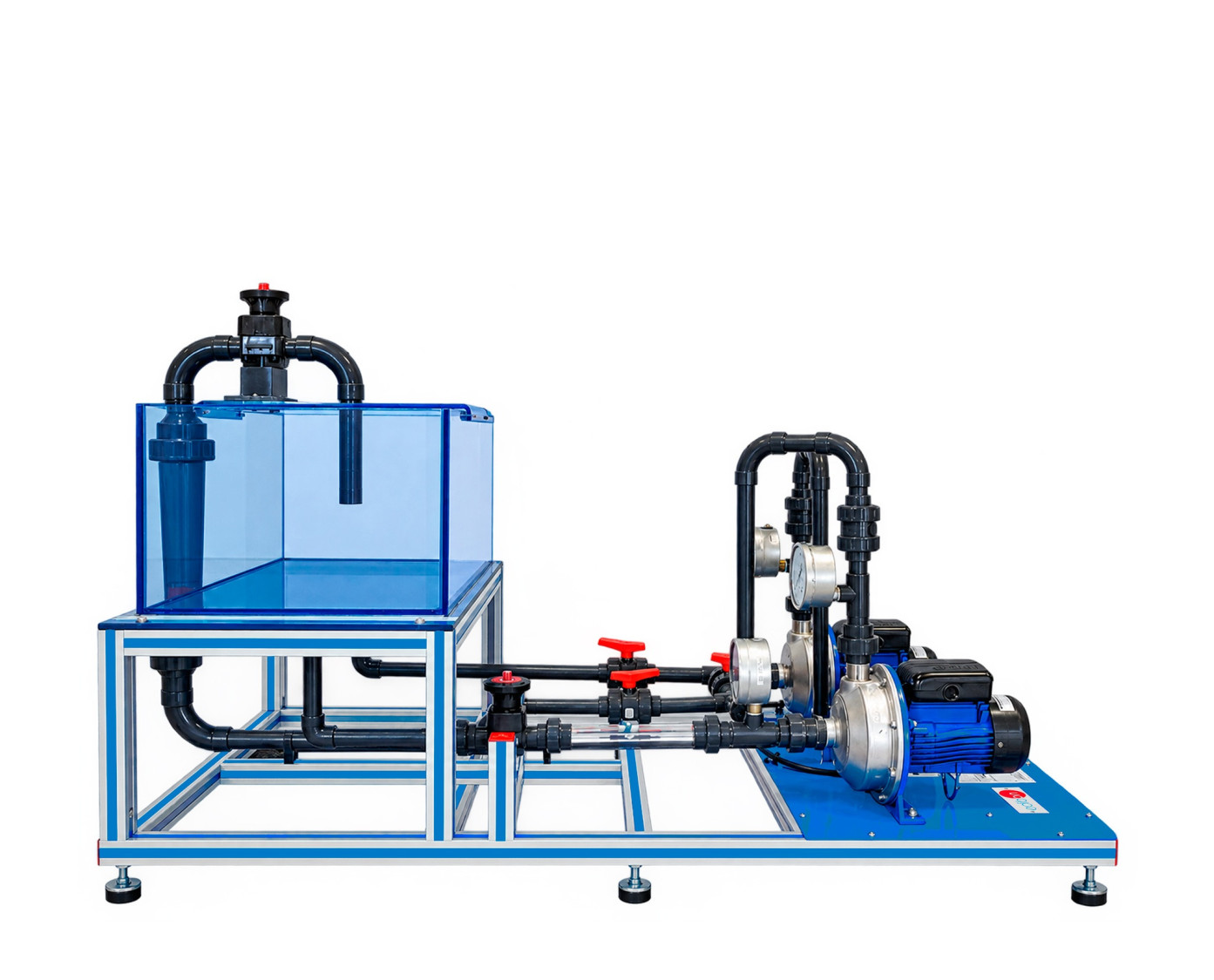
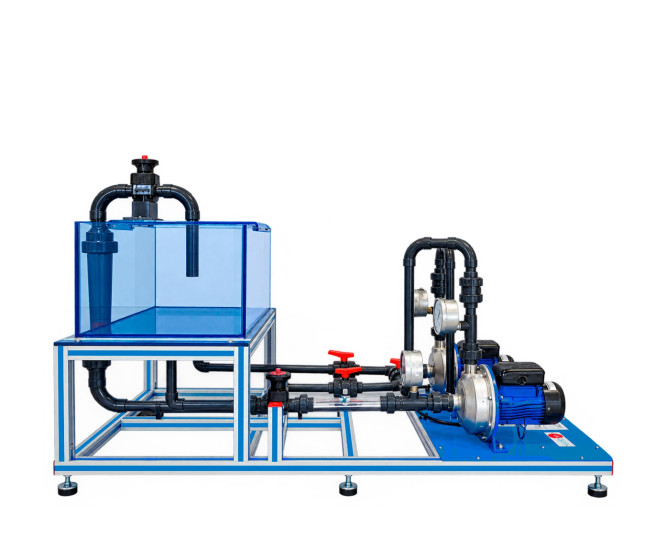
The Series/Parallel Pumps Bench, "PBSPB", has been designed by EDIBON to experimentally analyze the behavior of two centrifugal pumps operating individually or connected in series and parallel. The unit enables flow rate, pump head, power, and efficiency to be related to the operating conditions of the pumps, their characteristic curves and operating maps to be obtained, and changes in their hydraulic response to be studied when rotational speed or the coupling configuration is modified. It also enables the dimensionless study of the H*, N*, and Q* parameters, including pump head and flow rate expressed in dimensionless form, and the phenomenon of cavitation to be studied by obtaining required NPSH (NPSHr) curves.
The two centrifugal pumps are integrated into a closed hydraulic circuit with a water tank, avoiding continuous water consumption during the tests. By appropriately positioning the valves, the flow can be directed to operate each pump independently or to connect them in series or parallel. This configuration enables the different coupling arrangements to be directly compared and the resulting changes in flow rate and pressure to be observed.
One of the pumps is driven by a three-phase motor with continuous speed control by means of a frequency/voltage converter. This drive enables the rotational speed to be varied and both the speed and transmitted mechanical torque to be measured. The second pump is driven by a single-phase motor. The possibility of varying the speed of one of the pumps enables configurations in which both pumps have equivalent or different characteristics to be studied and their influence on the resulting series and parallel coupling curves to be analyzed.
The hydraulic instrumentation enables the suction and discharge pressures to be measured, while a flowmeter provides the circulating flow rate. These measurements, together with rotational speed and torque, enable the main H(Q), N(Q), and Rto%(Q) characteristic curves to be obtained and the hydraulic behavior to be related to the mechanical operating conditions.
The unit enables the operating map of a centrifugal pump to be obtained through tests under different operating conditions. Speed regulation also facilitates the dimensionless study of the H*, N*, and Q* parameters, enabling pump behavior to be analyzed using parameters independent of the specific test conditions.
The circuit arrangement also enables a cavitation test to be performed and the NPSHr curves to be obtained, analyzing the conditions under which this phenomenon occurs and its relationship with pump operation. In this way, the characteristic curves, the operating point, and the suction conditions required to avoid cavitation can be studied together.
When operating with two pumps, the Unit enables the series coupling of pumps with identical and different characteristics to be studied, as well as their parallel coupling under both conditions. These configurations enable the resulting curves to be experimentally compared and the way in which the combination of pumps modifies the available flow rate and head compared with individual operation to be analyzed.
 クッキーの設定

 カタログ
 コンテストの仕様