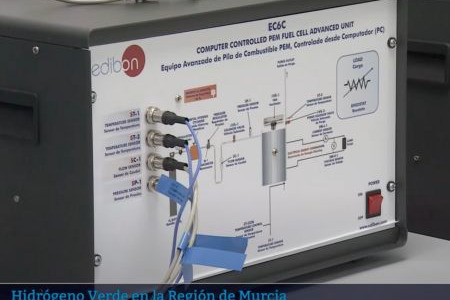
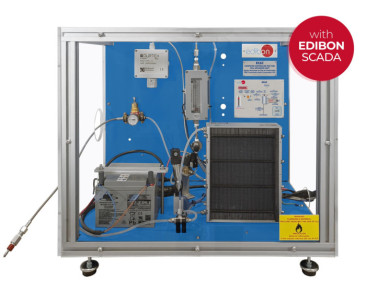
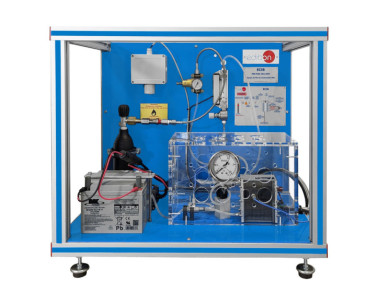
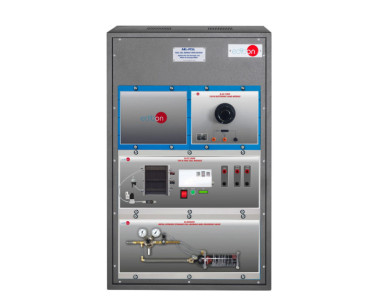
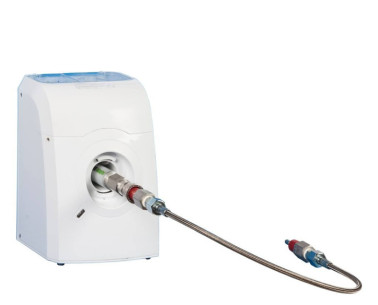
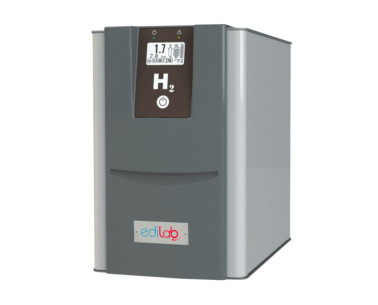
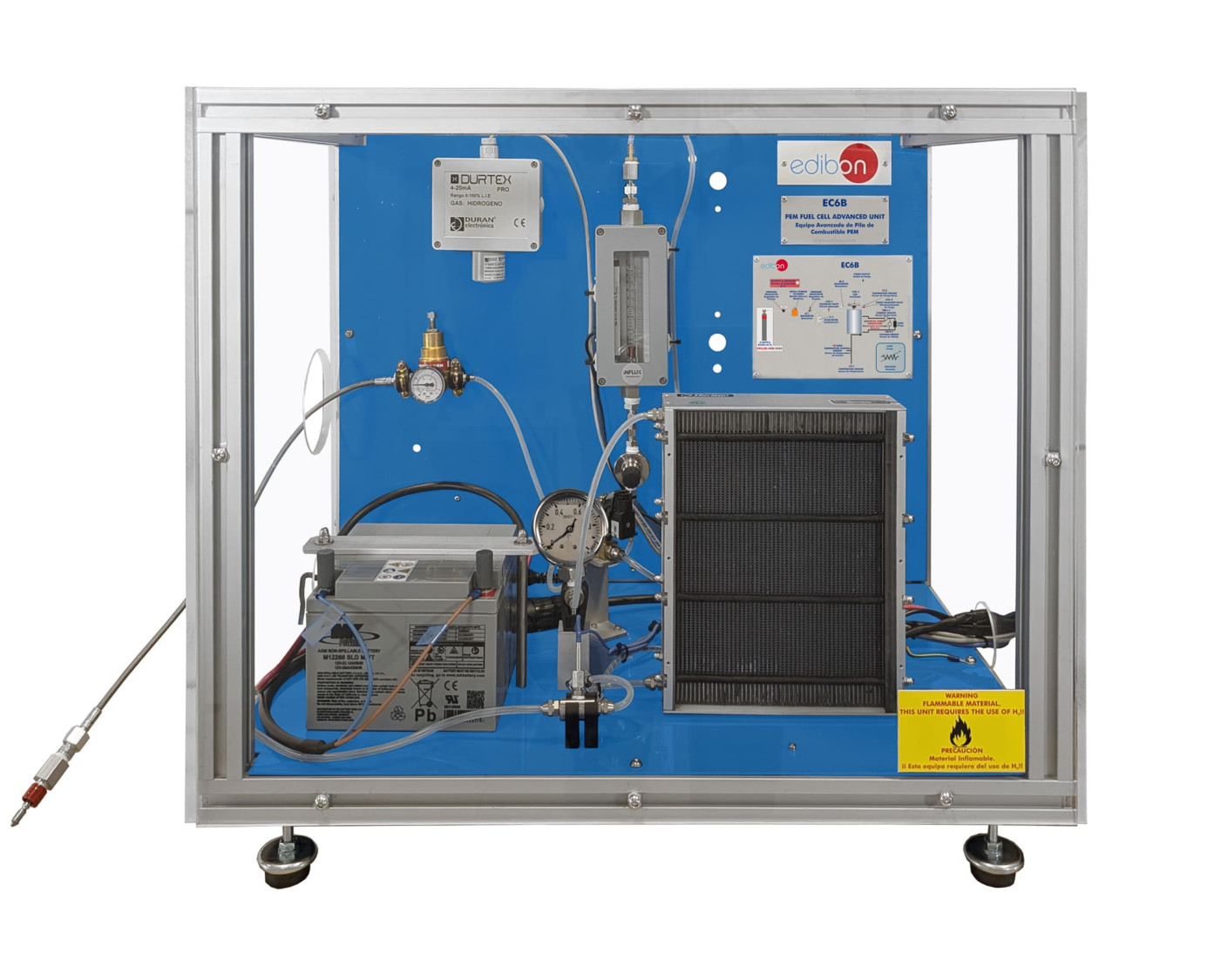
The PEM Fuel Cell Advanced Unit, "EC6B", has been designed by EDIBON to allow the students to understand the fuel cells technology, especially that of a proton exchange membrane fuel cell (PEM). It also enables to calculate several fundamental parameters of a PEM type fuel cell, such as power density, polarization curves, efficiency, etc., and the variation of some of these parameters in function of the consumption of reagents and the developed power.
The "EC6B" unit is supplied with a stack of proton exchange membrane fuel cells (PEM) with a rated power of 1000 W. The stack is composed of multiple cells with channelled plate shape that allow the air flow through the membrane. The membrane facilitates the hydrogen flow, generating the electrons release. There are separate plates which conduct electricity, allowing that electrons flow, between each pair of cells.
Cells are self-humidifying and do not require any type of external humidification.
The stack has an integrated fan that is able to provide the required air for proper operation and to maintain a suitable temperature.
Hydrogen storage represents one of the essential points regarding the hydrogen economy. For that purpose, includes two pressure regulators: one of them is prepared to be installed in the H2 bottle in order to regulate the outlet pressure at 5 – 50 bar, the other is placed at the outlet of the metal hydride bottle in order to regulate the inlet pressure to the stack in a range from 0 – 1 bar.
Two solenoid valves are included. One of them is located before the stack and controls the hydrogen inlet, and when the unit is switched off, the valve is closed to avoid any possible hydrogen leakage. The other valve, placed at the stack outlet, purges the excess of water and hydrogen outside for a proper operation.
The unit also has a load regulation system. It enables the study of the generated electrical energy, the representation of the characteristic operation curves and their comparison with the theoretical curves.
A battery supplies 12 V to the unit electronic console.
The whole electrical circuit of the stack is protected by a short-circuit unit in case of an overcurrent (30 A) and low voltage shut down (36 V).
It includes a hydrogen leak detector with a detection range from 0 – 2% Vol and from 0 – 100% L.E.L. (Lower Explosive Limit) respectively.
The unit is supplied with the suitable sensors and instrumentation for the most representative parameters measurements and controls (electronic console).
 Cookie-Präferenzen

 Katalog
 Wettbewerbsspezifikationen