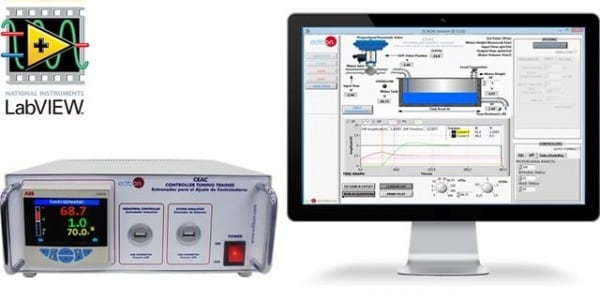
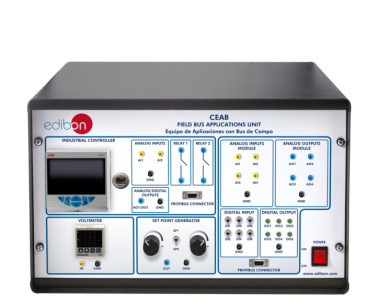
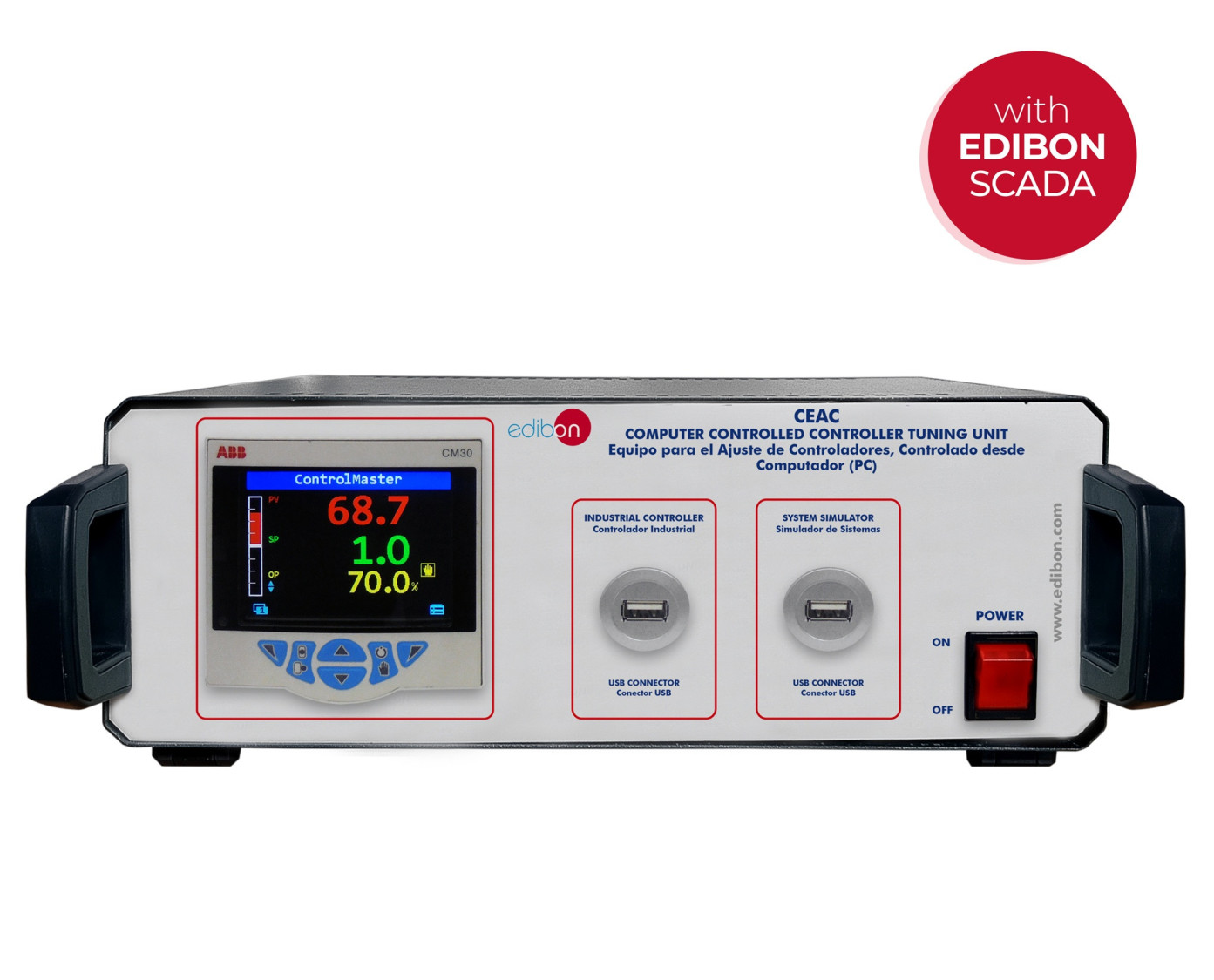
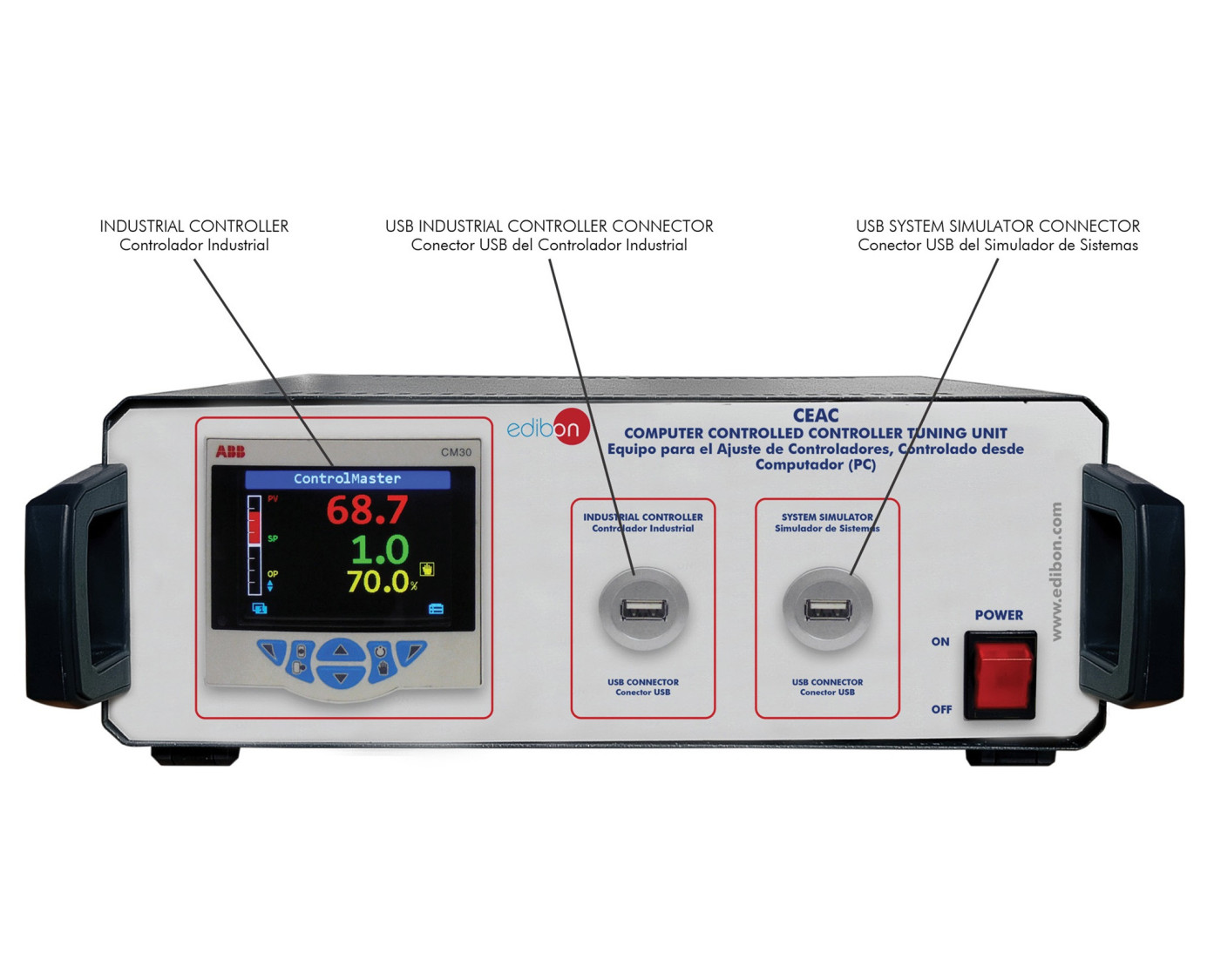
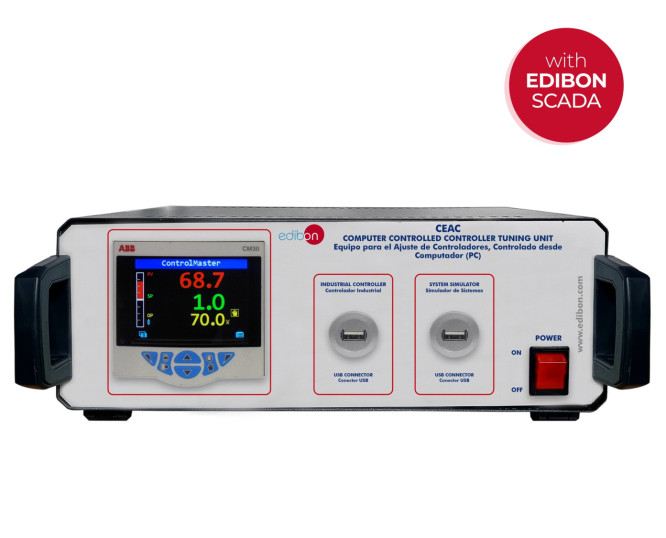
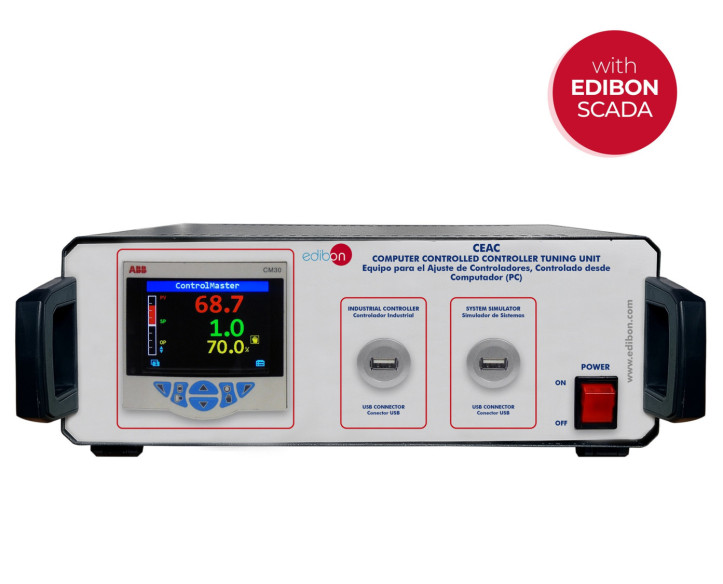
The Computer Controlled Controller Tuning Unit, "CEAC", has been designed by EDIBON for the experimental study of automatic control and industrial controller tuning through Hardware-in-the-Loop (HIL) simulation techniques. The unit enables the reproduction of the dynamic behavior of different industrial processes and the analysis of the response of a real industrial controller under various operating conditions, making it suitable for both educational and research applications in control engineering.
The unit operates together with a computer from which process variables are monitored, control signals are displayed, and controller parameters are modified. This configuration allows the practical study of the tuning and optimization procedures commonly used in industrial automation systems.
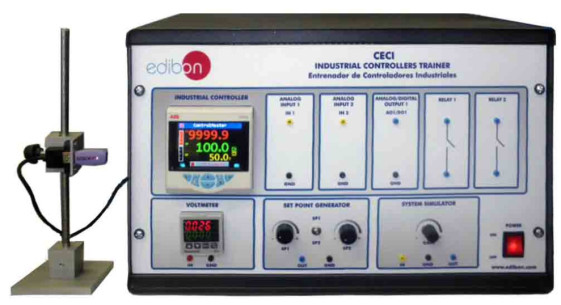
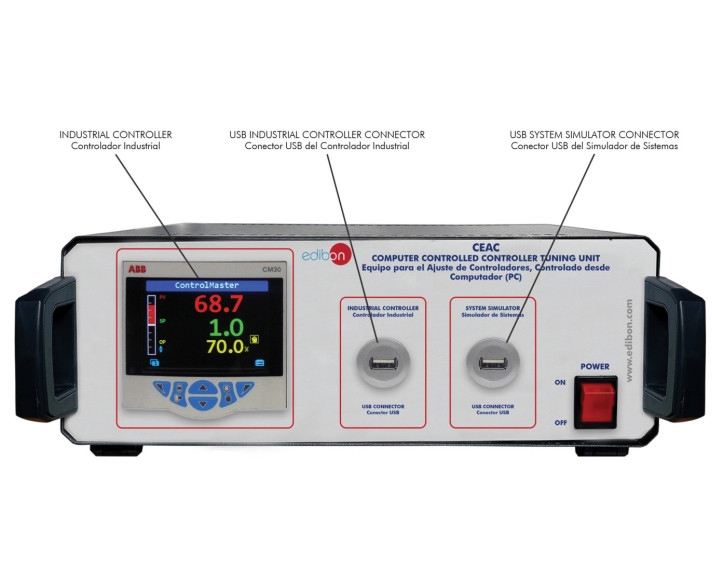
The system consists of two main elements: a commercial industrial controller and a real-time process simulator. Both devices communicate with the computer, facilitating experiment configuration and the monitoring of all variables involved in each test.
The industrial controller includes analog inputs and outputs that allow the implementation of control strategies in single-input, single-output (SISO) systems. Different industrial control algorithms can be configured and evaluated, including PID (Proportional-Integral- Derivative) control, pPI (Proportional-Integral-Predictive) control, and programmed parameter scheduling strategies for nonlinear systems.
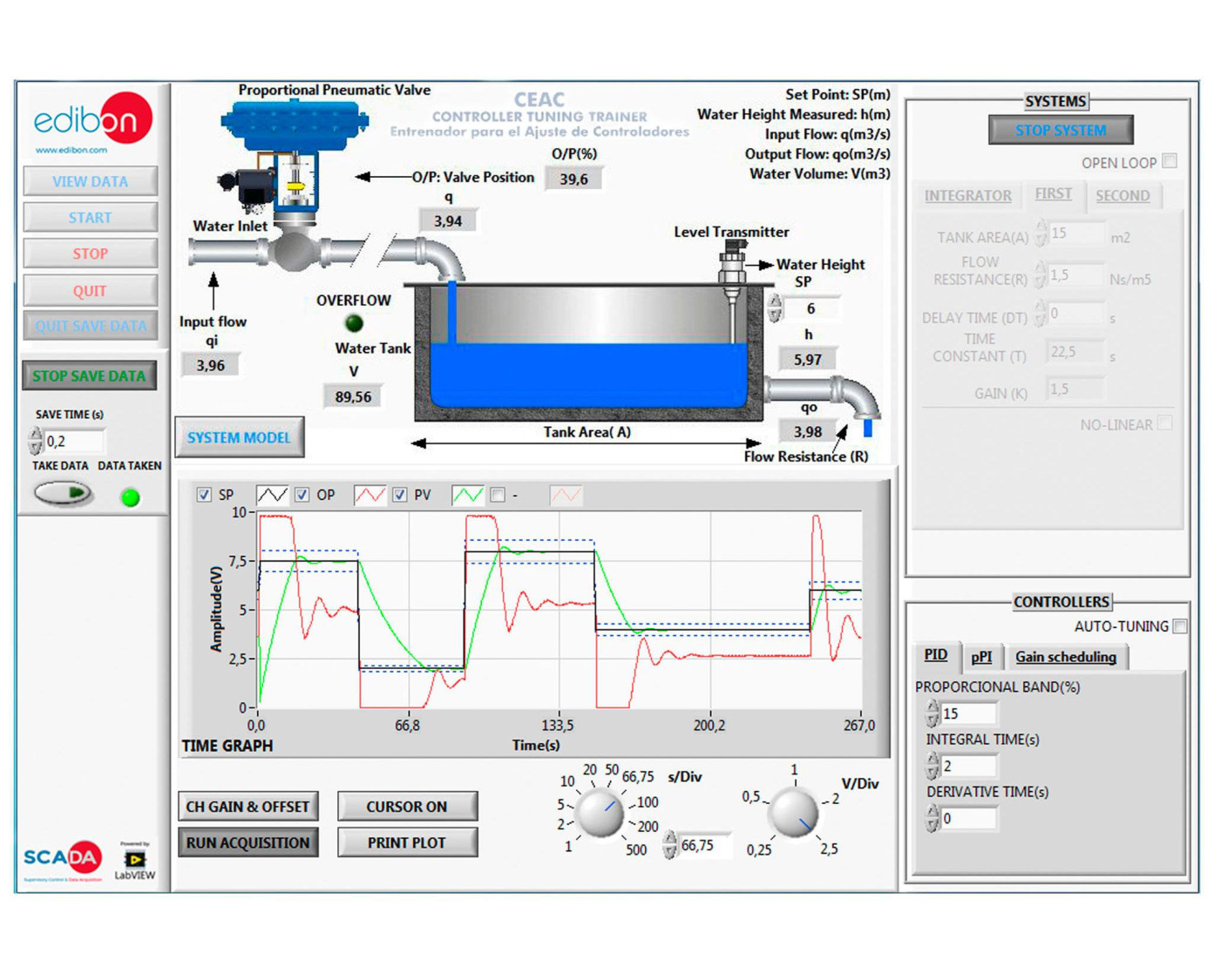
The process simulator reproduces, in real time, the dynamic behavior of different industrial systems using Hardware-in-the-Loop techniques. The processes that can be studied include integrating systems, first-order systems, second-order systems, systems with time delay, and systems with nonlinear actuators. The simulator receives the controller output signal and generates the corresponding process variable, closing the control loop in a manner equivalent to a real industrial installation.
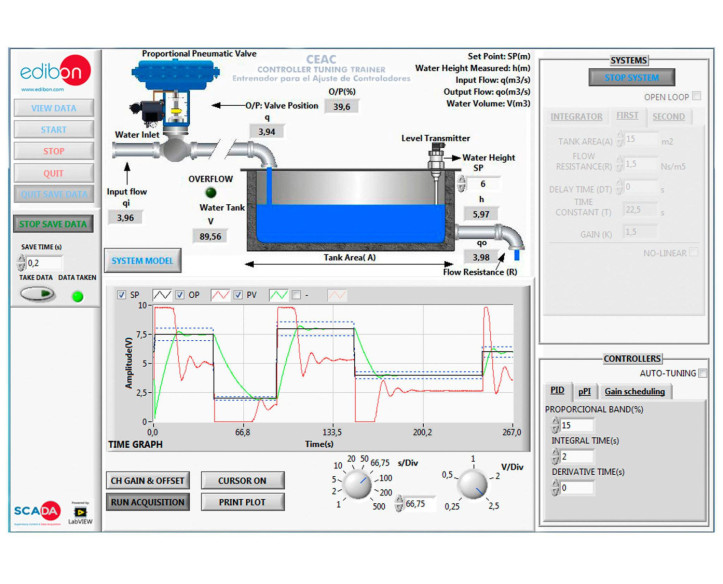
Thanks to this architecture, the unit allows the analysis of the influence of tuning parameters on stability, response time, overshoot, steady-state error, and other dynamic characteristics of the controlled system. It also facilitates the comparison of different control strategies and the evaluation of their behavior under setpoint changes and disturbances.
The unit is supplied with supervision and control software that enables real-time visualization of all process variables, experimental data acquisition, and graphical analysis of the response of the simulated systems. This allows users to develop practical skills in the configuration, tuning, and optimization of industrial controllers using methodologies commonly applied in real automation and process control applications.
This Computer Controlled Unit is supplied with the EDIBON Computer Control System (SCADA), and includes: The unit itself + Control Interface Box + Computer Control, Data Acquisition and Data Management Software Packages, for controlling the process and all parameters involved in the process.
 Preferências de cookies



 Catálogo
 Especificações de Concurso