AAIL Лаборатория прикладного искусственного интеллекта

ИННОВАЦИОННЫЕ СИСТЕМЫ

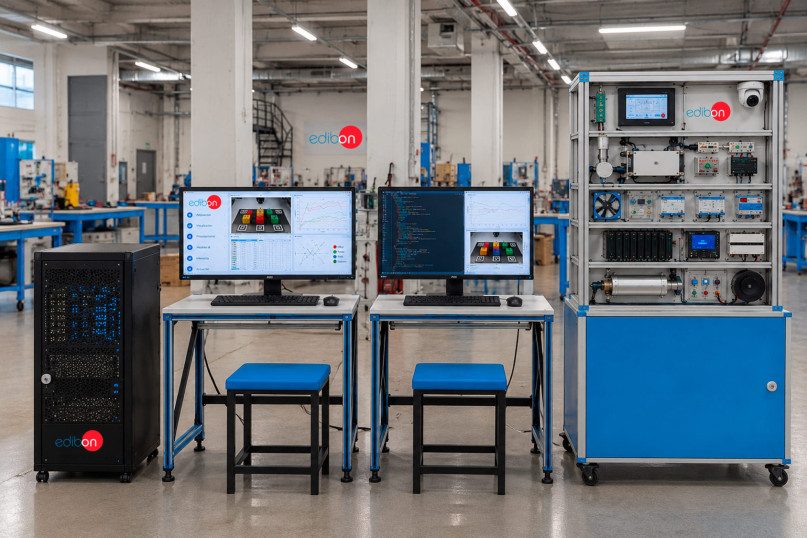
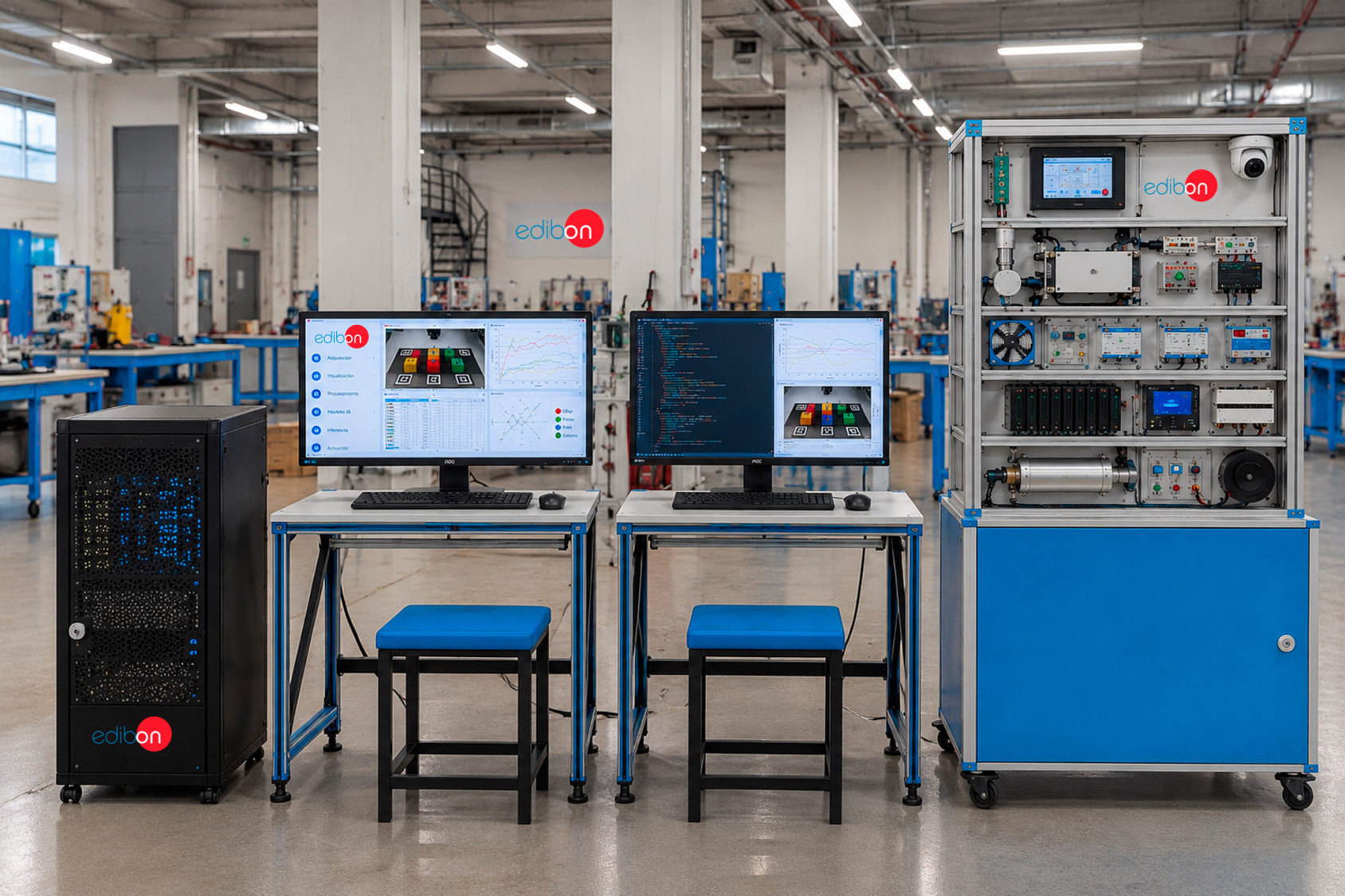
The Applied Artificial Intelligence Laboratory, "AAIL", has been designed by EDIBON for the practical study of the development and application of Artificial Intelligence solutions, integrating data acquisition, storage, Machine Learning, Deep Learning, machine vision, Edge Computing, IoT communications, and actuation on physical processes.

Посмотреть общее описание

ОБЩЕЕ ОПИСАНИЕ

The Applied Artificial Intelligence Laboratory, "AAIL", has been designed by EDIBON to study the complete development cycle of Artificial Intelligence applications using data from sensors, images, and physical process variables.

The laboratory enables different variables to be acquired using sensors and the resulting information to be stored to create datasets. These data can be prepared, analyzed, and used to develop and train different Machine Learning and Deep Learning models.

The developed models can be evaluated and subsequently used to make predictions, perform classifications, or detect specific patterns from new data.

For the study of machine vision, the laboratory includes a camera that enables image and video acquisition, the creation of custom datasets, and the development of recognition and classification applications using image processing and Artificial Intelligence techniques.

Model processing can be performed locally using Edge AI, enabling the study of applications in which data are processed close to where they are generated and results are obtained in real time.

The laboratory also incorporates different sensors and actuators, allowing the results obtained using Artificial Intelligence algorithms to be linked to actions on physical elements. In this way, students can understand the integration of data acquisition, Artificial Intelligence, and automation.

A data server enables the acquired data to be stored and queried, historical data to be analyzed, and changes in the different variables to be visualized. Communication between the different elements also enables the study of the fundamentals of IoT and communications applied to intelligent systems.

A workbench is included for use with this laboratory.

In this way, students can study the complete cycle of an applied Artificial Intelligence application in practice:

Acquisition →Storage →Data Preparation →Training →Evaluation →Inference →Decision →Actuation.
УПРАЖНЕНИЯ И ПРИМЕРЫ С ИНСТРУКЦИЯМИ

РУКОВОДСТВО ПО ПРАКТИЧЕСКИМ УПРАЖНЕНИЯМ ВКЛЮЧЕНО В РУКОВОДСТВО ПОЛЬЗОВАТЕЛЯ

Fundamentals of Artificial Intelligence and Machine Learning:

  1. Introduction to Artificial Intelligence, Machine Learning, and Deep Learning.
  2. Data acquisition and preparation.
  3. Creation of a dataset.
  4. Training a Machine Learning model.
  5. Evaluation and validation of a trained model.
  6. Making predictions from new data.

Sensors, IoT, and Data Acquisition:

  1. Acquisition of variables using sensors.
  2. Data transmission and storage using IoT communications.
  3. Real-time recording and visualization of variables.

Databases:

  1. Storage and querying of acquired data.
  2. Analysis and representation of historical data.

Machine vision:

  1. Camera-based image acquisition and processing.
  2. Creation of an image dataset.
  3. Training and use of a model for image classification.

Applied Artificial Intelligence:

  1. Using the result of an Artificial Intelligence model to actuate a physical element.

Additional practical exercises that can be performed with this unit:

Artificial Intelligence and Machine Learning:

  1. Comparison of different Machine Learning algorithms.
  2. Supervised and unsupervised learning.
  3. Analysis of accuracy and classification errors.
  4. Obtaining and interpreting confusion matrices.
  5. Study of the influence of training data.
  6. Optimization of training parameters.
  7. Development of artificial neural networks.
  8. Optimization of models for execution using Edge AI.

Data analysis and management:

  1. Data processing and handling using scientific computing tools.
  2. Development of extraction, transformation, and loading (ETL) processes.
  3. Export and exchange of datasets.
  4. Comparison between real-time acquired data and historical data.
  5. Creation of customized dashboards.
  6. Statistical analysis of acquired variables.

IoT and communications:

  1. Communication between sensors, Edge devices, and server.
  2. Implementation of communications using MQTT.
  3. Implementation of communications using HTTP.
  4. Development of web services for information exchange.
  5. Remote monitoring of variables.
  6. Development of data acquisition and telemetry nodes.

Machine vision:

  1. Classification of objects by color.
  2. Object identification using machine vision.
  3. Detection of non-defective and defective pieces.
  4. Real-time object tracking.
  5. Development of image processing filters and algorithms.
  6. Study of the influence of lighting conditions.
  7. Development of custom machine vision applications.

Automation and applied Artificial Intelligence:

  1. Motor control based on acquired variables.
  2. Temperature control using the thermoelectric module.
  3. Regulation of variables using control algorithms.
  4. Use of Machine Learning models to classify the state of a process.
  5. Detection of anomalous behavior through data analysis.
  6. Use of inference results for automatic decision-making.
  7. Integration of sensors, Artificial Intelligence, and actuators.
  8. Development of custom applied Artificial Intelligence applications.
Узнать больше

КАЧЕСТВО

ПОСЛЕПРОДАЖНОЕ ОБСЛУЖИВАНИЕ

Запросить информацию